
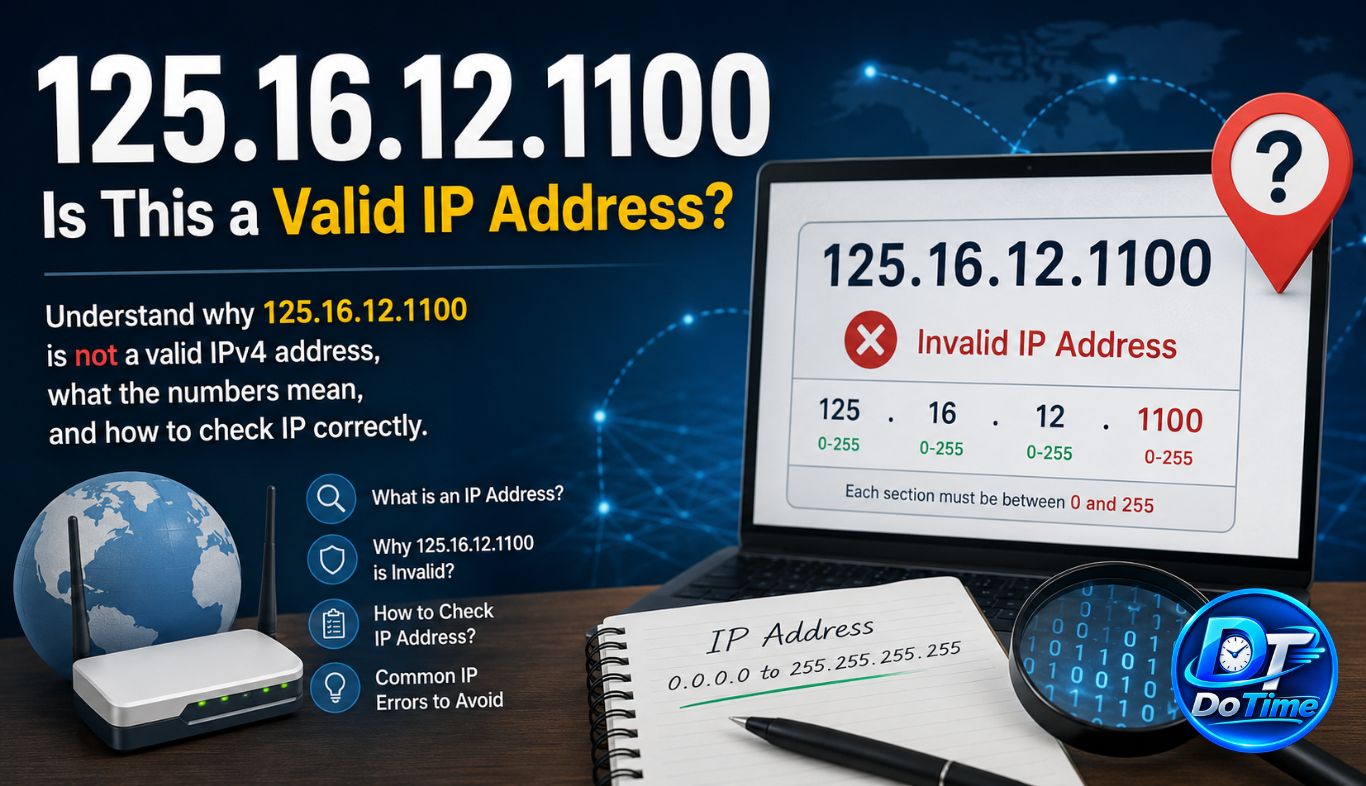
125.16.12.1100: Is This a Valid or Invalid IP Address?
The string 125.16.12.1100 looks like an IP address at first glance. It has numbers separated by dots, which is the familiar format used for IPv4 addresses. However, there is an important problem: the final section, 1100, is outside the valid range for an IPv4 address.
For readers in India who have encountered 125.16.12.1100 in a browser, network setting, server log, configuration file, or technical document, the key point is simple: 125.16.12.1100 is not a valid standard IPv4 address.
Understanding why it is invalid can help you identify typing mistakes, configuration problems, and misleading information. It also helps to know what a genuine IPv4 address looks like and how to check one before using it in a network configuration.
What Is 125.16.12.1100?
125.16.12.1100 is an incorrectly formatted IPv4-style address. It contains four sections separated by periods:
- 125
- 16
- 12
- 1100
The first three sections can fit within the normal IPv4 range. The problem is the fourth section.
A standard IPv4 address contains four decimal numbers, and each number must be between 0 and 255. This format is defined by Internet standards describing IPv4 addressing.
Because 1100 is greater than 255, the complete string cannot represent a conventional IPv4 address.
This is not simply a matter of the address being unusual. The value itself violates the basic format used for IPv4 dotted-decimal notation.
Why 125.16.12.1100 Is Not a Valid IPv4 Address
The easiest way to understand the problem is to look at the structure of IPv4.
An IPv4 address has 32 bits divided into four 8-bit sections. Each section is therefore capable of representing values from 0 through 255.
For example:
125.16.12.110
can fit the basic numerical range because every section is between 0 and 255.
However:
125.16.12.1100
does not fit because the final section contains the value 1100.
The important distinction is that IPv4 does not allow an arbitrarily large number in an individual section. Each dotted section represents an 8-bit value.
The 0–255 Rule
The maximum value of an 8-bit number is 255.
That gives the following general rule:
| IPv4 section | Valid range |
|---|---|
| First octet | 0–255 |
| Second octet | 0–255 |
| Third octet | 0–255 |
| Fourth octet | 0–255 |
Since the fourth section of 125.16.12.1100 is 1100, the address fails this basic test.
The Internet Engineering Task Force’s documentation describes IPv4 addresses as 32-bit values written as four decimal numbers, each ranging from 0 through 255 and separated by dots.
Understanding the Four Parts of an IPv4 Address
Each section of a dotted IPv4 address is commonly called an octet.
For example, consider:
192.168.1.25
It contains four octets:
- 192 — first octet
- 168 — second octet
- 1 — third octet
- 25 — fourth octet
All four values fall between 0 and 255, so the address follows the basic IPv4 format.
Now compare that with:
125.16.12.1100
The first three octets are numerically acceptable:
- 125 is valid
- 16 is valid
- 12 is valid
But 1100 is not valid as an IPv4 octet.
Therefore, the complete address is invalid.
Could 125.16.12.1100 Be a Typing Mistake?
Yes. A malformed address can result from a simple data-entry or formatting error.
For example, someone might accidentally combine numbers that should have been separated by a period. They might also add an extra digit while copying an address from another source.
However, you should not automatically assume what the intended address was.
For instance, 1100 could potentially be an incorrectly entered value such as 110, but there is no reliable way to determine the intended address from the string alone.
This matters when troubleshooting a network. Guessing the missing or incorrect digit could lead you to the wrong device or configuration.
Instead, check the original source.
Where Might You Encounter 125.16.12.1100?
Because the string is not a valid standard IPv4 address, its appearance does not by itself identify a real internet-connected device.
You might encounter it in several situations.
Network Configuration
A manually entered address could contain a typo. This can happen when administrators copy addresses between configuration files, dashboards, or devices.
Before saving a network configuration, verify every octet.
Logs and Monitoring Systems
Applications sometimes record malformed user input or invalid network-related strings.
If 125.16.12.1100 appears in a log, check the surrounding information rather than treating the string as a confirmed source IP.
Look for:
- Timestamp
- Application name
- Request details
- Original input
- Related hostname
- Other network fields
This can help determine whether the value came from a genuine network field or from application data.
Documentation
An incorrectly written address may also appear in a technical document, spreadsheet, tutorial, or internal note.
If you are responsible for maintaining the document, correct the entry after confirming the intended address.
Software Input
Web applications and network tools may receive IP-like strings from users or external systems.
Good software should validate the input instead of assuming that every dotted number is a legitimate IPv4 address.
What Happens If You Try to Use 125.16.12.1100?
The exact behavior depends on the software receiving the value.
A browser, operating system, application, router, or programming library may reject the string during validation.
In other cases, the application may interpret it differently or return an error. Therefore, it is better not to assume that every program will produce exactly the same message.
The important point is that it does not satisfy the standard dotted-decimal IPv4 format.
If you are trying to connect to a server and this address appears in your configuration, check the original IP address before troubleshooting the connection itself.
How to Check Whether an IPv4 Address Is Valid
You can perform a basic manual check in a few seconds.
Step 1: Count the Sections
A standard dotted IPv4 address should have four numerical sections separated by three dots.
For example:
8.8.8.8
has four sections.
Step 2: Check Every Number
Make sure every section falls between 0 and 255.
For example:
125.16.12.110
passes the basic range test.
125.16.12.1100
does not.
Step 3: Check for Missing Dots
A missing period can join two values together.
For example, two intended sections could accidentally become one larger number. This is a common type of formatting problem worth checking when an address looks unusual.
Step 4: Check the Original Source
If the address came from a router, server, website, email, application, or administrator, compare it with the original information.
Do not modify an address based only on guesswork.
Is 125.16.12.1100 a Public or Private IP?
It is neither a valid public nor a valid private IPv4 address in its written form.
This distinction is important.
People sometimes focus on whether an address is public or private before checking whether it is structurally valid. Validation should come first.
Private IPv4 address ranges include commonly used blocks such as 10.0.0.0/8, 172.16.0.0/12, and 192.168.0.0/16. An address outside those private ranges is not automatically a public address in every possible sense, because IPv4 has additional special-purpose ranges.
For 125.16.12.1100, however, the more fundamental issue is that the fourth octet is invalid.
Is 125.16.12.1100 Related to IPv6?
No. IPv6 uses a completely different textual format.
IPv6 addresses are 128-bit addresses normally represented using hexadecimal groups separated by colons. IPv4, by comparison, uses a 32-bit address represented by four decimal components.
For example, an IPv6 address may look like:
2001:db8::1
That does not mean the 0–255 rule has disappeared from IPv4. The two protocols simply use different addressing formats.
What Should You Do If You Found 125.16.12.1100?
If this value appeared unexpectedly, start by identifying where it came from.
If it is in a configuration file, compare it with the original network information.
If it appears in a log, inspect the surrounding record and determine which field produced it.
If someone gave you the address for a server or device, ask them to confirm the correct IPv4 address rather than guessing.
You can also use an IP-address validation function in your operating system, programming language, or network software. Such validation is preferable to relying only on a regular expression because proper validation should confirm both the structure and the numerical ranges.
Common Mistakes When Working With IP Addresses
Several simple mistakes can create invalid IP-like strings.
Adding an Extra Digit
An octet such as 110 can become 1100 through accidental typing.
Removing a Period
Two separate values can become one larger value if a decimal separator is omitted.
Copying From an Incorrect Source
A spreadsheet, document, or message may contain a transcription error.
Confusing Ports With IP Addresses
A port number is not another octet. For example, a notation such as:
192.168.1.10:8080
contains an IPv4 address followed by a port number.
The 8080 is not part of the IPv4 address.
This distinction is particularly useful when reading server configuration files and URLs.
Why Correct IP Formatting Matters in India
The same IPv4 standards apply in India as they do elsewhere on the internet.
Whether you are configuring a home Wi-Fi router, troubleshooting an office network, managing a cloud server, or working with a website hosted in India, an IPv4 address must follow the applicable addressing format.
For everyday users, this means you do not need specialized networking knowledge to spot the basic problem with 125.16.12.1100.
Simply remember the four-part structure and the 0–255 range.
For IT professionals, developers, and system administrators, proper validation is even more important because malformed network data can create configuration and troubleshooting problems.
FAQs About 125.16.12.1100
Is 125.16.12.1100 a valid IP address?
No. It is not a valid standard IPv4 address because the final octet is 1100, while each IPv4 octet must be between 0 and 255.
What is wrong with the number 1100 in 125.16.12.1100?
The number 1100 is too large to be an IPv4 octet. IPv4 uses four 8-bit sections, and an 8-bit value can range only from 0 through 255.
Could 125.16.12.1100 be a server address?
Not as a standard IPv4 address in that exact form. If you received it as a server address, verify the original information because the value may contain a typing or formatting error.
How can I check an IPv4 address manually?
Count the four sections separated by dots, then make sure every section contains a valid decimal value from 0 through 255. If any section exceeds 255, the address is not valid in standard dotted-decimal IPv4 notation.
Should I be worried if 125.16.12.1100 appears in a log?
Not necessarily. Its presence alone does not prove malicious activity. It could result from malformed input, a software or logging issue, or a simple typing error. Investigate the surrounding log information before drawing conclusions.
Conclusion
125.16.12.1100 is not a valid standard IPv4 address. Although it looks similar to a normal IP address, its final section, 1100, exceeds the IPv4 limit of 255.
The easiest way to identify the problem is to remember that IPv4 uses four decimal octets, with each octet ranging from 0 to 255.
If you encounter 125.16.12.1100 in a configuration, log, document, or message, do not guess what the intended address was. Check the original source and verify the correct value before making network changes.
That simple validation step can prevent unnecessary troubleshooting and help keep network configurations accurate.